Zero Room for Doubt – Inspecting Safety-Critical Concrete
Nuclear containment buildings, reactor buildings, and offshore concrete structures are among the most demanding concrete assets to inspect. They are built to demanding standards because the consequences of failure can be severe — which means construction-stage defects that might be tolerated elsewhere can require careful investigation in safety-critical structures. Post-tensioned containment walls may incorporate grouted tendon ducts, where complete and effective grouting is important for long-term tendon protection. Offshore shafts, cells, and other heavily reinforced concrete members depend on sound, well-consolidated concrete in structures where intrusive testing can be particularly challenging.
At the same time, these are precisely the structures where destructive or intrusive testing can require careful planning. Coring or other intrusive testing of containment structures or offshore concrete members may require engineering review, consideration of reinforcement and prestressing systems, and subsequent repair. Elop Insight provides a non-destructive testing (NDT) alternative — high-coverage, repeatable ultrasonic imaging with one-sided access, without drilling, coring, gel, or water. The resulting inspection data provides a traceable record of concrete thickness, internal condition, embedded features, and potential internal defects to support engineering assessment and aging-management programs.
How Elop Insight Supports Nuclear and Offshore Concrete Inspection
For owners, operators, and regulators
-
Documented condition: Aging-management programs, maintenance planning, and life-extension assessments require reliable evidence of internal condition. Large-area ultrasonic scan data provides a traceable and repeatable record that can be retained for future comparison.
-
Non-intrusive by design: One-sided access and dry-coupled scanning allow inspection without drilling or coring through the concrete being investigated.
-
Life-extension support: Many nuclear and offshore assets are expected to operate for extended service periods. Reliable information about concrete thickness and internal condition can support engineering assessments and decisions related to continued service.
For inspectors and engineers
-
Tendon duct assessment: Detection and mapping of post-tensioning ducts and identification of potential grouting defects, including voids and incomplete grouting that can increase the risk of tendon corrosion.
-
Embedded object detection: Mapping of tendon ducts, penetrations, plates, and other embedded features before intrusive work or other interventions.
-
Concrete thickness and internal condition: Mapping of concrete thickness, backwall position, and internal reflectors in thick containment and offshore concrete walls.
-
Repeatable inspection: Encoder-positioned scans stored in the Insight Portal allow the same area to be re-scanned and compared over time, supporting condition monitoring and aging-management programs.
For society
-
Safety: Nuclear and offshore structures perform critical safety and environmental protection functions. Reliable information about their condition supports informed inspection, maintenance, and engineering decisions.
-
Energy transition: Extending the service life of nuclear and offshore assets, including structures being adapted for new energy applications, requires reliable data on their condition.
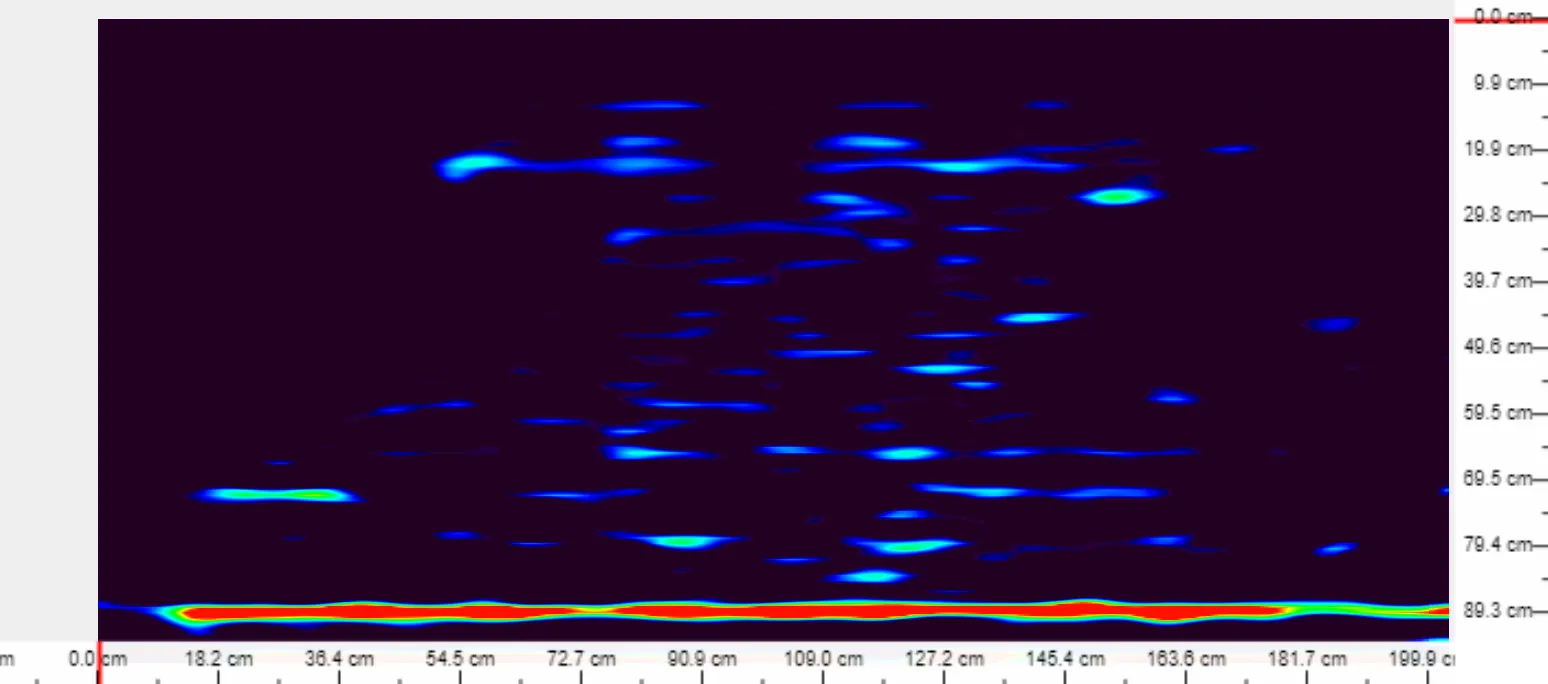
Figure 1: D-scan image showing the backwall echo corresponding to a concrete thickness of 90 cm in an offshore structure with multiple layers of reinforcement and post-tensioning cables.
What Elop Insight Can Detect in Nuclear and Offshore Concrete
-
Grouting defects in tendon ducts: Potential voids, incomplete grouting, and other internal anomalies in post-tensioning ducts.
-
Concrete thickness and internal condition: Mapping of concrete thickness, backwall position, and internal reflectors in thick containment walls, shafts, and other concrete structures.
-
Honeycombing and voids: Construction-stage consolidation defects and internal voids, including in heavily reinforced concrete sections.
-
Embedded objects: Mapping of tendon ducts, penetrations, plates, reinforcement, and other embedded features to support inspection planning and intrusive work.
-
Delamination and internal interfaces: Detection and mapping of internal reflectors associated with delamination, debonding, and changes between concrete layers or structural elements.
Practical Considerations
Very heavy reinforcement, thick concrete sections, and variations in moisture condition can affect ultrasonic signal penetration and interpretation. Inspection planning for nuclear and offshore structures is therefore carried out case by case, often beginning with a pilot inspection on a defined area.
Ultrasonic inspection can also complement other non-destructive testing methods such as ground-penetrating radar (GPR). While GPR can be highly effective for locating reinforcement and embedded objects, ultrasonic imaging provides additional information about internal concrete condition, including potential voids, delamination, and grouting defects.
Where a project requires qualification or performance demonstration of an inspection method, Elop can support the evaluation with application-specific performance data, including results documented in the Elop Insight white paper.
From Compliance to Confidence
For safety-critical concrete, reliable inspection data is an important part of responsible asset management. Repeatable 3D ultrasonic imaging can turn each inspection campaign into a permanent, comparable condition record — providing engineers, owners, and operators with better information for maintenance planning, aging management, and life-extension assessments.
Contact us to discuss a qualified pilot inspection.