Introduction
Reliable inspection of concrete structures is essential for evaluating durability, safety, and maintenance requirements. Many critical defects, such as cracks, voids, honeycombing, delamination, and poorly compacted areas, develop beneath the surface and cannot be identified through visual inspection alone.
Traditional non-destructive testing (NDT) methods provide valuable information about concrete condition, but imaging internal structures can be challenging due to the heterogeneous nature of concrete. Aggregates, reinforcement, air voids, and defects influence ultrasonic wave propagation and can make conventional measurements difficult to analyze.
Elop Insight uses advanced ultrasonic scanning combined with SAFT (Synthetic Aperture Focusing Technique) to perform high-resolution 3D imaging of concrete structures for non-destructive testing and condition assessment. By improving focusing and signal interpretation, SAFT enables clearer visualization of internal features.
This technology helps engineers perform faster and more informed assessments while reducing the need for unnecessary destructive investigations.
What is SAFT in Ultrasonic Concrete Inspection?
SAFT (Synthetic Aperture Focusing Technique) is an ultrasonic imaging algorithm used to improve the spatial resolution and quality of reconstructed images. The method combines ultrasonic measurements acquired from multiple positions and focuses the recorded signals to specific locations within the inspected volume.
The basic principle of SAFT is similar to synthetic aperture techniques used in radar, sonar, medical ultrasound, and other imaging applications. Instead of relying on a single measurement, SAFT combines information from multiple measurements to create a more accurate representation of internal structures.
For ultrasonic concrete inspection, this approach is particularly valuable because concrete is a complex material where wave scattering and attenuation can reduce image quality.
How SAFT Works in Ultrasonic Concrete Inspection
When ultrasonic waves propagate through concrete, they interact with different material features. Changes in material properties, such as cracks, voids, aggregates, or interfaces, generate reflected signals that contain information about internal conditions.
During scanning, ultrasonic signals are recorded from multiple measurement positions. The SAFT algorithm uses the measured signals together with the scanning geometry and estimated wave velocity to calculate focusing delays for different points inside the inspected volume.
By applying these focusing delays, SAFT enhances the reconstructed image and provides a clearer representation of internal features compared with analyzing individual ultrasonic measurements.
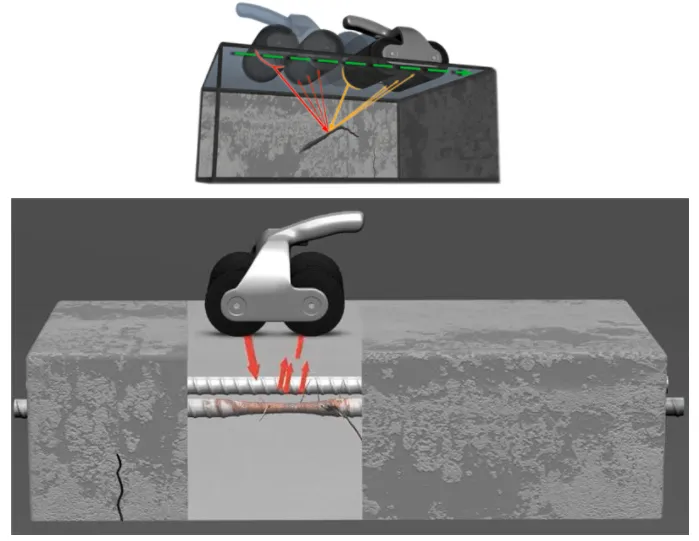
Figure 1: SAFT imaging principle in Elop Insight. Ultrasonic signals transmitted from the Tx wheel are received by the Rx wheel. The same internal feature is captured through multiple Tx-Rx combinations and scanner positions, enabling 3D reconstruction.
Full Matrix Capture and SAFT-Based 3D Reconstruction
Advanced ultrasonic imaging systems often use Full Matrix Capture (FMC). FMC is an acquisition technique where every transmit element is sequentially excited and signals are recorded on multiple receiving elements, creating a complete dataset for advanced reconstruction.
The FMC dataset contains information from multiple transmit–receive combinations. This enables advanced reconstruction algorithms to focus ultrasonic energy at different locations within the inspected volume. Advanced reconstruction methods, including SAFT and Total Focusing Method (TFM), can process this information to generate focused images.
For concrete inspection, the combination of high-density ultrasonic acquisition and advanced reconstruction algorithms enables:
- Improved visualization of internal concrete features
- Better localization of defects
- Increased confidence in inspection results
- Three-dimensional representation of inspected volumes
- Elop Insight applies these principles to transform ultrasonic measurements into interpretable 3D images of concrete structures.
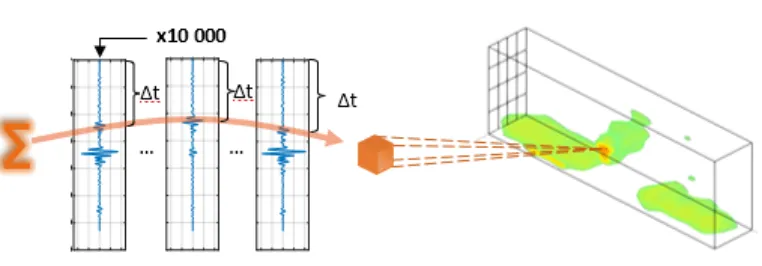
Figure 2: SAFT delay-and-sum reconstruction principle. Raw A-scans from the receiver are delayed and summed according to the calculated propagation distance between transmitter, voxel, and receiver, together with the estimated material velocity. For Elop Insight, each voxel amplitude is typically updated approximately 10,000 times, improving signal-to-noise ratio (SNR) and enabling high-resolution 3D visualization.
Benefits of SAFT-Based Ultrasonic Imaging for Concrete Inspection
Improved Detection of Internal Defects
Many important concrete defects are hidden below the surface and cannot be detected through visual inspection.
SAFT-based reconstruction improves the visualization of internal features such as:
- Honeycombing
- Voids and cavities
- Cracks
- Delamination
- Areas with reduced material quality
By improving image focusing, SAFT helps inspectors better understand the location and extent of potential defects.
Three-Dimensional Visualization of Concrete Structures
Conventional ultrasonic testing often provides information from individual measurement points or limited inspection paths.
SAFT-based 3D reconstruction provides a volumetric representation of the inspected area. This allows engineers to evaluate:
- Defect position
- Defect depth
- Internal geometry
- Spatial distribution of anomalies
This additional information supports better engineering decisions during structural assessment.
Reduced Need for Destructive Testing
Concrete assessment often requires a balance between obtaining sufficient information and minimizing damage to the structure.
By providing detailed information about internal conditions, ultrasonic 3D imaging can help identify areas requiring further investigation and reduce unnecessary coring or destructive examinations.
Efficient Large-Area Inspection
Unlike conventional point-by-point ultrasonic inspection, Elop Insight uses a rolling ultrasonic scanner to collect high-density measurements continuously while moving across the concrete surface. This enables rapid scanning of large areas while maintaining detailed information about internal concrete conditions.
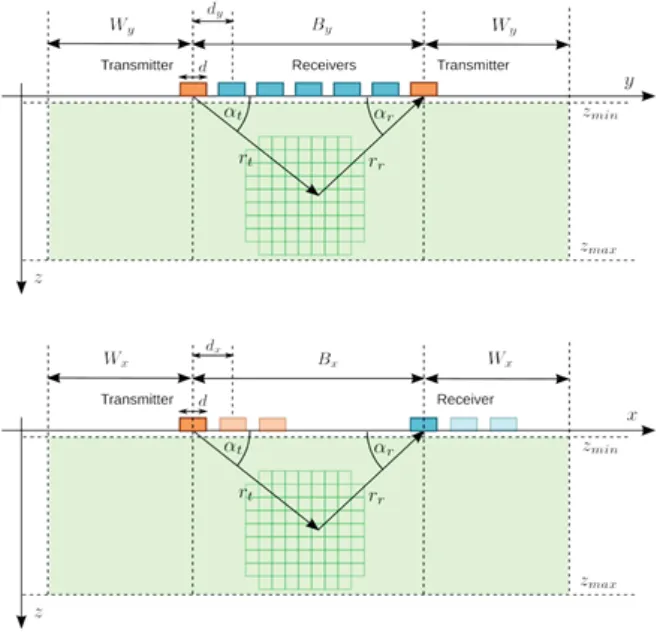
Figure 3: SAFT reconstruction geometry for cross-track and along-track imaging directions.
SAFT Compared with Traditional Concrete Inspection Methods
Different inspection techniques provide different levels of information about concrete structures.
Visual inspection is useful for identifying surface damage but cannot reveal hidden defects. Conventional ultrasonic measurements can detect internal anomalies but may provide limited spatial information when used individually.
SAFT-based ultrasonic imaging improves this process by combining multiple measurements into a focused representation of the inspected volume.
Compared with traditional approaches, SAFT-based imaging provides:
- Higher-resolution ultrasonic visualization
- Improved defect localization
- Better understanding of internal conditions
- More comprehensive inspection results
- This makes SAFT particularly suitable for large concrete structures where inspection speed and coverage are critical.
Elop Insight: Advanced 3D Ultrasonic Concrete Scanner
Elop Insight integrates rolling ultrasonic scanning with advanced reconstruction algorithms to provide an efficient solution for large-area concrete inspection.
The collected ultrasonic data is processed to generate detailed images of internal concrete structures.
By combining efficient data acquisition with advanced reconstruction techniques such as SAFT, Elop Insight enables engineers and inspectors to:
- Evaluate large concrete areas efficiently
- Identify suspicious internal regions
- Visualize hidden defects
- Make better-informed maintenance decisions
The technology supports a more data-driven approach to non-destructive testing of concrete structures.
Conclusion
SAFT is an important technology for improving ultrasonic imaging of concrete structures. By combining multiple ultrasonic measurements and applying advanced reconstruction algorithms, SAFT enables clearer visualization of internal features and defects.
When integrated into Elop Insight, SAFT-based 3D reconstruction provides a faster and more reliable approach for non-destructive concrete inspection. The technology helps engineers understand internal concrete conditions, prioritize areas requiring further investigation, reduce unnecessary coring, and improve the efficiency of structural evaluation.
References
[1] D. H. Johnson and D. E. Dudgeon. Array Signal Processing: Concepts and Techniques. Signal processing series. Prentice Hall, Englewood Cliffs, NJ, USA, 1993.
[2] M. Soumekh. Fourier Array Imaging. Prentice Hall, Englewood Cliffs, NJ, USA, 1994.
[3] W. G. Carrara, R. S. Goodman, and R. M. Majewski. Spotlight Synthetic Aperture Radar: Signal Processing Algorithms. Artech House, Norwood, MA, USA, 1995.
[4] D. Massonnet and J. Souyris. Imaging with synthetic aperture radar. EFPL Press, 2008. ISBN 0849382394.
[5] R. E. Hansen. Introduction to Synthetic Aperture Sonar. In N. Z. Kolev, editor, Sonar Systems, chapter 1, pages 3–28. Intech, September 2011. ISBN 978-953-307-345-3. URL
[6] M. P. Hayes and P. T. Gough. Synthetic Aperture Sonar: A Review of Current Status. 34(3): 207–224, July 2009.
[7] C. Holmes, B. W. Drinkwater, and P. D. Wilcox. Post-processing of the full matrix of ultrasonic transmit–receive array data for non-destructive evaluation. NDT & E International, 38(8), 701–711, 2005.
[8] L. W. Schmerr Jr. Fundamentals of Ultrasonic Nondestructive Evaluation: A Modeling Approach. Springer, 2016.
[9] J. A. Turner and R. B. Thompson. Total focusing method for ultrasonic array imaging. NDT related publication.