Concrete repair and maintenance are essential for ensuring the safety, durability, and longevity of critical infrastructure. Although concrete is known for its strength and durability, concrete structures are still vulnerable to deterioration over time due to environmental exposure, structural loading, and aging. This is especially critical in modern concrete repair and maintenance workflows that rely on non-destructive testing (NDT) techniques for accurate condition assessment.
Common issues in reinforced concrete structures include cracking, delamination, voids, honeycombing, corrosion of reinforcement, and moisture penetration. Freeze-thaw cycles, chloride attack, carbonation, chemical exposure, and repeated loading can significantly reduce the lifespan of concrete infrastructure if not identified and repaired early. Detecting and addressing these problems at an early stage is crucial to preventing costly repairs and structural failure.
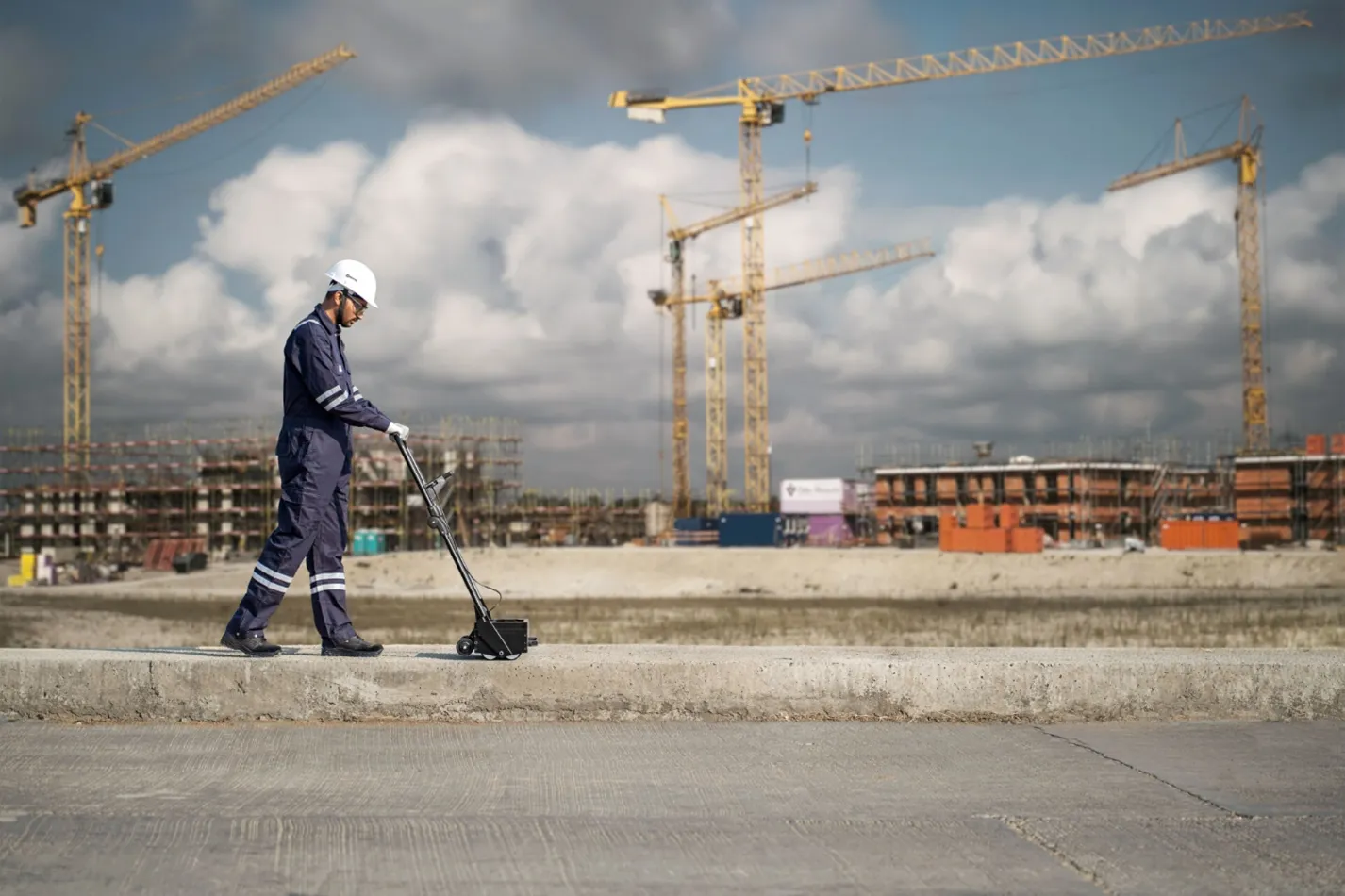 Figure 1: An inspector scanning concrete structure using the Elop Insight (EI) scanner
Key Challenges of Concrete Inspection and Condition Assessment
One of the major challenges in concrete infrastructure condition assessment and maintenance planning is accurately evaluating the structural integrity of concrete. Many defects develop below the surface and are difficult to identify through visual inspection alone.
To assess the condition of concrete structures effectively, engineers rely on a combination of NDT methods and inspection technologies. Common NDT techniques include:
-
Ground Penetrating Radar (GPR)
-
Ultrasonic testing and ultrasound scanners
-
Schmidt hammer testing
-
Impact echo testing
-
Cover meter measurements
-
Half-cell potential measurements
-
Strain gauge monitoring
These inspection methods complement each other and provide valuable insight into the internal condition of concrete structures.
Advanced Ultrasound Scanning for Concrete Repair and Maintenance
The EI scanner is designed to inspect and map concrete structures quickly and efficiently while rolling across the surface. Unlike traditional ultrasonic inspection systems, the scanner uses dry coupling technology, eliminating the need for coupling fluids during scanning.
The scanner can detect a wide range of subsurface defects and structural features, including:
-
Cracks
-
Delaminations
-
Voids
-
Honeycombing
-
Reinforcement bars (rebars)
To generate high-resolution inspection data, the system uses the Synthetic Aperture Focusing Technique (SAFT) algorithm for image reconstruction. This enables detailed 3D visualization and tomographic imaging of the concrete interior.
In addition to imaging, the scanner also provides insight into the relative distribution of ultrasonic wave velocity within the concrete structure. Variations in wave velocity can help identify deteriorated areas, internal defects, or changes in material quality. This information supports more accurate condition assessment and enables timely maintenance decisions.
3D Imaging and Data-Driven Concrete Maintenance
Modern concrete inspection increasingly relies on digital workflows and data-driven maintenance strategies. Advanced ultrasonic imaging allows engineers and asset owners to monitor infrastructure health, prioritize repairs, and move from reactive maintenance toward predictive maintenance.
The Elop Insight system generates real-time 3D reconstructed images of concrete structures, making it possible to inspect large areas efficiently and document internal conditions with high precision.
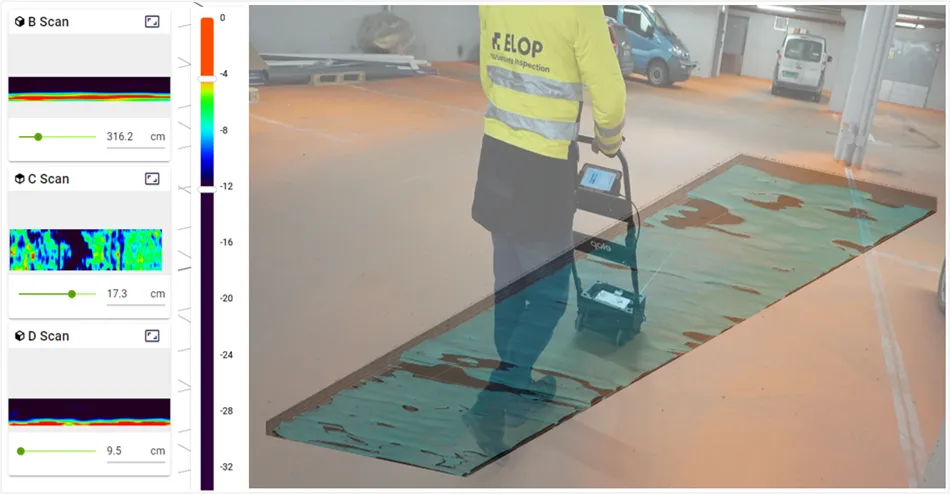
Figure 2: A 3D reconstructed image of a parking garage obtained using the Elop Insight scanner, showing floor thickness variations over an area of approximately 10 square meters. Shadows visible in some areas are caused by features located closer to the surface. Selected 2D slices from the scanned volume are also shown.
This type of digital inspection data can improve maintenance planning, reduce lifecycle costs, and extend the service life of concrete infrastructure. It also contributes to sustainability by reducing unnecessary demolition and reconstruction.
Sustainable Concrete Repair and Preventive Maintenance
As aging infrastructure continues to grow globally, the need for effective concrete repair and preventive maintenance becomes increasingly important. Bridges, tunnels, parking structures, dams, nuclear facilities, and other reinforced concrete assets require regular assessment to maintain safety and operational reliability.
Extending the lifespan of existing structures through accurate inspection and targeted repair not only improves safety but also reduces environmental impact. Concrete production is responsible for a significant share of global carbon emissions, making infrastructure preservation and lifecycle extension increasingly important for sustainable construction practices.
Conclusion
Concrete repair and maintenance involve several technical and operational challenges, especially when dealing with hidden subsurface deterioration. Advanced non-destructive testing methods such as ultrasonic concrete scanning provide valuable insight into the internal condition of structures and support more effective maintenance planning.
By combining accurate inspection data, 3D imaging, and predictive maintenance strategies, asset owners and engineers can improve structural safety, reduce repair costs, and extend the lifespan of critical concrete infrastructure for years to come.