Introduction
Concrete ultrasound imaging is widely used in non-destructive testing (NDT) to detect rebars, tendon ducts, voids, delamination, cracks, and other subsurface defects. One of the major challenges in ultrasonic testing of concrete is image artifacts caused by multiple wave modes, scattering, and reflections. These artifacts can reduce image quality and make interpretation more difficult. This article describes how advanced signal and image processing techniques implemented in the Elop Insight concrete ultrasound scanner reduce artifacts, improve signal-to-noise ratio (SNR), and enhance the quality of concrete ultrasound imaging. These techniques further enhance the quality of the EI scanner’s real-time 3D concrete ultrasound imaging capabilities.
When acoustic waves are emitted into a complex solid medium like concrete, several acoustic wave modes are generated, and these different wave modes are reflected and scattered from interfaces and internal features such as backwalls/sidewalls, rebars, pipes, aggregates, voids etc. These reflections and scatterings can occur multiple times and interfere constructively or destructively. Sometimes these effects can cause very complex wave patterns propagating within the concrete which in turn can be seen as large amplitude variations, noise, and artifacts in the images. These undesired artifacts make the images more challenging to interpret, and a considerable amount of research is being conducted to reduce these effects. [1]- [6]
In this article we will introduce and present some results from EI’s new signal processing approaches to reduce these artifacts and improve the images to make the results more easily interpretable. We will focus on a dynamic filtering approach to reduce artifacts generated by surface acoustic waves (SAWs) and directional filtering to improve SNR, attenuate artifacts, and reduce amplitude variations.
Surface Wave Suppression in Concrete Ultrasound Imaging
One of the wave modes generated when ultrasound is emitted into concrete is compression waves, which the EI scanner is currently utilizing to image the internal features of the concrete material. Other wave modes, however, such as shear waves and surface acoustic waves are unwanted during the imaging process and will interfere with the compression waves and contaminate the signals. Of the two contaminating wave modes, surface waves are by far the most prominent and can in some circumstances be several orders of magnitude higher in amplitude than the reflected compression waves from internal features. On the other hand, SAWs can be beneficial for other types of inspections, and are utilized by the EI scanner to estimate wave velocity and will also in a coming update be used to estimate compressive strength. Surface waves are generated to some degree by all NDT ultrasound devices and are handled and utilized by using various approaches [2][3][4].
In images generated by the EI scanner, the SAW contamination, when prominent, will appear as several bands in the near surface region which can be visible from a few centimeters’ depth up to around 20 cm. The extent and severity of SAW contamination depend on several factors, concrete quality, acoustic coupling, and material velocity.
Although the EI scanner already uses several techniques to reduce SAW contamination such as acoustically optimized elastomer coupling and the use of 3D SAFT algorithm, it is still insufficient in some cases. We are using a locally adaptive filtering method which, among other characteristics, considers the length and direction of travel of the SAWs to attenuate them while preserving real features.
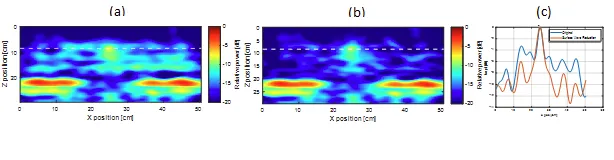
Figure 1. D-scan ultrasound image of a near-surface air-filled tendon duct in concrete before and after surface wave artifact suppression.
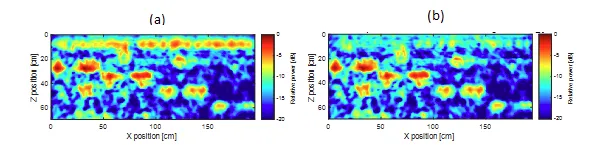
Figure 2. Concrete ultrasound D-scan showing multiple air-filled ducts before and after adaptive surface wave filtering.
Along-Track and Cross-Track Smoothing for Improved Signal-to-Noise Ratio
Concrete is a highly diverse medium with various aggregates, air pores, reinforcement density etc. These variations will cause scattering and attenuation of the signal and could result in very complex and cluttered images with fragmented features. By averaging across larger segments of the 3D image, extended features appear more continuous, resulting in a more easily interpretable image. In addition, the amplitude of the larger objects can often be more accurate as the smaller local variations, which are often caused by properties that are not of interest, will be averaged out, and the amplitude will be based on measurements from a larger area [6]. The cost of applying this extended averaging is resolution and attenuation of smaller features.
In EI’s analysis tool there is currently introduced two directional weighted average filters, along-track, and cross-track smoothing, which allows the user to apply a stronger filtering of noise and artifacts to make the images cleaner and the features more connected, primarily when the direction of elongated features is known. The along-track smoothing is beneficial when scanning along a feature, such as following a tendon duct to monitor amplitude differences for detecting grouting defects. For the cross-track filtering a further advantage is that it will interpolate the stitched scan lines, and the inherent fall-off towards the edges of the scanning system, and remove the discontinuities between the adjacent scans, making the image appear more unified.
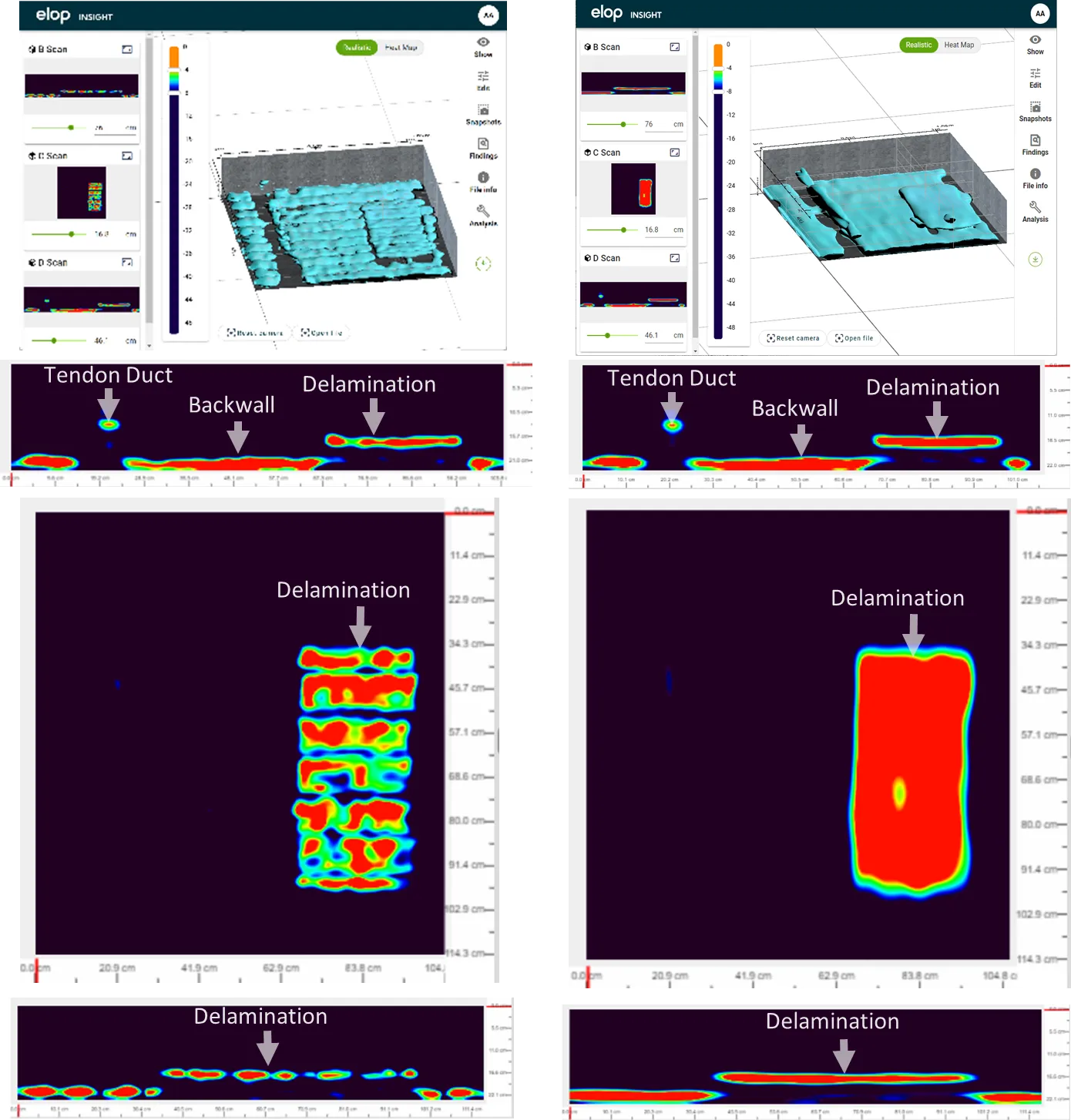
Figure 3. 3D concrete ultrasound image showing tendon ducts and subsurface features after directional smoothing and image enhancement.
Benefits for Concrete Inspection and NDT
The combination of advanced signal processing, artifact suppression, and image enhancement provides several advantages for concrete inspection:
-
Improved visibility of tendon ducts and embedded objects
-
Reduced interference from surface acoustic waves
-
Higher signal-to-noise ratio (SNR)
-
Better defect detection capability
-
More reliable interpretation of ultrasonic data
-
Faster and more efficient non-destructive testing workflows
Conclusion
Advanced signal and image processing techniques play a critical role in improving concrete ultrasound imaging. By suppressing surface acoustic wave artifacts and applying directional smoothing filters, the Elop Insight scanner delivers cleaner images, improved signal-to-noise ratio, and more reliable interpretation of subsurface features such as tendon ducts, voids, delamination, and reinforcement.
These enhancements help engineers and inspectors perform faster, more accurate, and more reliable ultrasonic testing of concrete structures.
Related Resources
Learn more about related technologies and applications:
References
[1] D. H. Johnson and D. E. Dudgeon. Array Signal Processing: Concepts and Techniques. Signal processing series. Prentice Hall, Englewood Cliffs, NJ, USA, 1993.
[2] Lee, Y. H., & Oh, T. (2016). The measurement of P-, S-, and R-wave velocities to evaluate the condition of reinforced and prestressed concrete slabs. Advances in Materials Science and Engineering, 2016.
[3] Kroggel, O., Schickert, M., & Schnapp, J. (2003). Statistical Evaluation Of Ultrasound Images Of Concrete Structures. Journal of Nondestructive Testing, 8(4), 1-7.
[4] R. Jansohn and M. Schickert (1998). Objective Interpretation of Ultrasonic Concrete Images. Proceedings of the 7th ECNDT, European Conference on Nondestructive Testing Copenhagen.
[5] Contreras Ortiz, S. H., Chiu, T., & Fox, M. D. (2012). Ultrasound image enhancement: A review. Biomedical Signal Processing and Control, 7(5), 419–428.
[6] Feissel, M., Lewandowski, W. A comparative analysis of Vondrak and Gaussian smoothing techniques. Bull. Geodesique 58, 464–474 (1984).